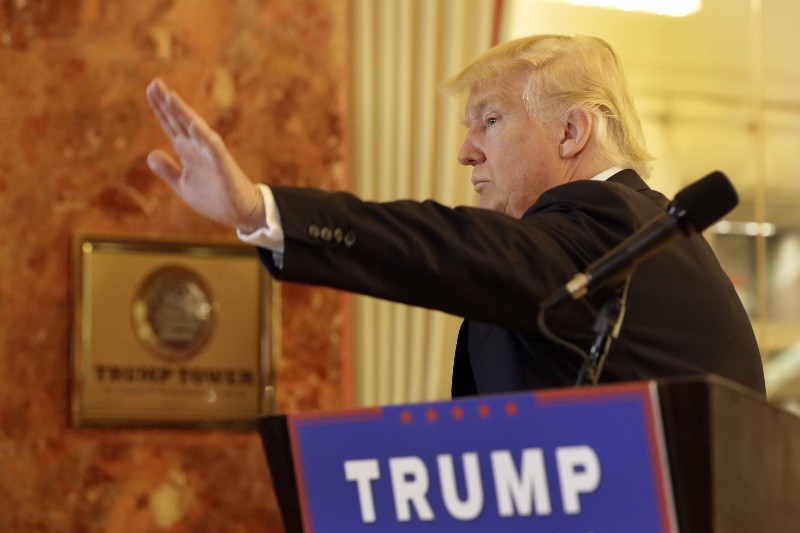
Even as Donald Trump’s press conferences usually go, Tuesday’s was a barn burner. The original focus of the post-Memorial Day event was his donations to veterans groups, after the Washington Post uncovered that Trump did not distribute most the $6 million he claimed to have raised month ago to charities benefiting former servicemembers. But the conference quickly devolved into a heated back-and-forth on the definition and purpose of critical journalism, with the GOP nominee slamming the press both individually and collectively as “dishonest,” “sleazy,” and “disgusting.” Some reporters tried to defend themselves, arguing that asking tough questions of powerful figures is literally their job, but these attempts only resulted in more name-calling from Trump.
“The press should be ashamed of themselves,” he railed, before one of his surrogates took the mic and instructed the group of reporters to “get your head out of your butt.”
Political analysts have repeatedly blamed the press for not being critical enough of Trump early on, arguing they fueled his rise to power. But Tuesday’s press conference — and many other journalist-Trump clashes over the past year — reveal Trump’s ability to stymie any attempt at critical reporting on him. Amid the inane press conference questions on gorillas and puffball call-in TV interviews have been real efforts to dig into his business records, family background, mountain of lawsuits, conflicts of interest and more. But by effectively using the carrots of access and the sticks of public shaming, he has curried favorable coverage and convinced his supporters that any critical pieces about him are full of lies.
Here are the ways reporters have attempted to handle The Donald and how The Donald has neutralized them:
1. Ask tough questions, lose access
From the beginning of Trump’s campaign, some journalists have tried to hold the candidate’s feet to the fire on both his policies and his rhetoric. Last summer, when many outlets were still treating Trump as a joke who had no chance at winning the nomination, Univision’s Jorge Ramos attempted to pin him down on his immigration policy. Specifically, how would Trump fulfill his promise to deport 11 million undocumented people? The question got Ramos, one of the world’s highest profile Latino reporters, thrown out of Trump’s Iowa press conference.
When Ramos attempted to ask the same question in a written letter to Trump’s campaign, Trump “doxxed” him, releasing his personal cell phone number online. “He acted in an incredibly authoritarian way,” Ramos told CNN. “And that’s dangerous for press freedom in the United States.”
Many other reporters have been blacklisted and denied access to Trump’s events after asking the candidate tough questions — including those from the Huffington Post, National Review, the Des Moines Register, Univision, BuzzFeed, the Daily Beast, Fusion, and more — while some simply get ignored.
Asked @realDonaldTrump as he was leaving if he still disavowed all pro Trump PACs. He looked at me, paused for a sec, then walked out.
— Ali Vitali (@alivitali) May 31, 2016
2. Ask softball questions, learn nothing
A surefire way to maintain access to the Trump campaign is to ask uncritical questions and stroke the mogul’s ego. Nowhere is this clearer than on Fox News, where a single show’s host has enjoyed dozens of lengthy interviews with Trump. While other reporters struggle to ask the candidate even one question, Sean Hannity has spent as much as an hour a week face to face with the GOP nominee. Yet the very reason he has that access — sticking to flattering questions like, “Are you kind of leading the way [in fighting political correctness]?” — means these interviews have produced no news of value to the American public.
Another Fox host, Megyn Kelly, incurred the wrath of Trump several months ago by asking him about his long record of disparaging women. Trump responded by calling her a “lightweight” and “highly overrated,” and implying she had been menstruating. He also boycotted a presidential debate because Kelly was one of the co-moderators. Taking his cue, his supporters bombarded her with insults and death threats.
Months later, Kelly is a changed woman. In her first sit-down interview with Trump since their public feud, she stuck to soft questions like, where was Trump and what was he wearing when firing off mean tweets about her? The much-hyped broadcast also included questions about Trump’s favorite movie and book. The “soft-as-a-grape,” “no-news interview,” was widely mocked.
3. Carve a middle path, face ridicule
Many reporters have attempted to walk a fine line between covering Trump critically and keeping him just happy enough to maintain access to his campaign. At Tuesday’s press conference, ABC’s Tom Llamas praised Trump’s personal donation of $1 million to veterans groups as “incredibly generous.” But he followed it up by grilling the candidate on his exaggerations and misleading statements about that donation. Trump responded by repeatedly calling Llamas a “sleaze” and refusing to answer his question.
The exchange that led Trump to call me a "sleaze." 👇 pic.twitter.com/dDwsjR4IlF
— Tom Llamas (@TomLlamasABC) May 31, 2016
The same pattern has played out many times on cable TV. CNN’s Chris Cuomo recently opened an interview with Trump by saying, “We need to talk policy,” and attempting to dive into questions about his campaign strategy. Trump huffed, “Well, this is a nice way to start off the interview. First of all, you should congratulate me for having won the race. I thought, you know, at least there would be a small congratulations.” Cuomo then moved to placate the candidate, saying: “Hold on, Mr. Trump, I did congratulate you the last time we spoke. I said congratulations on winning the big race.” Trump effectively turned the rest of the interview into a diss track about CNN.
Donald Trump Gets Pissy At Chris Cuomo For Not Bowing To The KingDonald Trump Gets Pissy At Chris Cuomo For Not Bowing To The Kingembed.crooksandliars.com
4. Investigate him, receive threats
Some smart reporters have realized that the real news often lies far away from the circus of Trump’s press conferences and campaign rallies. But those who have attempted to investigate Trump’s family, finances, and work history have been sued, harassed, threatened, and publicly insulted by Trump and his supporters.
After GQ Magazine reporter Julia Ioffe published an in-depth profile of Trump’s wife Melania and his Slovenian in-laws, she received a torrent of abusive and threatening messages on social media, many of them specifically referencing her Jewish heritage. She also received so many harassing and threatening e-mails and phone calls — some of them blasting audio of Hitler’s speeches — that she filed a formal police report.
At least they're fluent in 80s pop culture? pic.twitter.com/4pTTfa7jhE
— Julia Ioffe (@juliaioffe) April 28, 2016
Melania Trump told DuJour magazine that Ioffe bore the responsibility for “provoking” her supporters by doing journalism. “What right does the reporter have to go and dig in court in Slovenia in 1960 about my parents?” the potential future first lady demanded. DuJour reporter Mickey Rapkin then mused, “I can’t help but wonder what kind of hate speech her supporters might unleash on me for asking a few pointed questions.”
Several years before Trump’s White House bid began, journalist Tim O’Brien dug into his tax and business records when researching his book TrumpNation: The Art of Being The Donald. When he uncovered that Trump is not nearly as wealthy as he claims, Trump sued him for libel, asking for $5 billion in damages. A New Jersey judge sided against Trump, saying, “There were no significant internal inconsistencies in the information provided by the confidential sources, nor was there ‘reliable’ information that contradicted their reports.” Trump maintains O’Brien has “total disregard for the facts,” and years after the lawsuit still slams him as “a whack job, a total nut job…one of the sleaziest people I’ve ever done business with.”
By repeatedly returning to the “reporters are liars” well, Trump effectively inoculates himself from critical reporting; his supporters can simply tell themselves that any unflattering article is a false and malicious hit piece. And after seeing what happened to Ioffe, O’Brien and others attacked by Trump, fewer reporters may dare to write such probing pieces in the future.
***
A vision of the next four years
Tuesday’s heated back-and-forth between Trump and a gaggle of reporters fed up with his constant insults and evasions of their questions ended with a dark warning about what the next four years could hold. Asked if he would treat the press differently if he wins the election, Trump responded, “It is going to be like this…You think I’m gonna change? I’m not gonna change.”
Over nearly a year on the campaign trail, Trump has shown exactly how he would treat the media if he became president. He has attempted to dictate the camera angles TV reporters use, told his interviewers that basic information like his tax returns is none of their business, confined the press in a metal cage at public events, attacked individual reporters by name, and promised to make it easier to sue reporters. One reporter who attempted to work outside the designated media pen was threatened with arrest, while others who somehow angered the Trump campaign have been thrown out and barred from future events, spat on, and tackled to the ground. Trump also threatened retaliation against the owner of the Washington Post after learning that the paper had assigned more than a dozen reporters to investigate him.
Those concerned with press freedom should be connecting these dots. As CNN’s Dana Bash observed after Tuesday’s heated press conference, the ability of reporters to ask tough questions of powerful people is “what makes us different than North Korea.” Coincidentally, North Korea’s highly-controlled, propagandist state media recently praised Trump, calling him a “wise politician.”