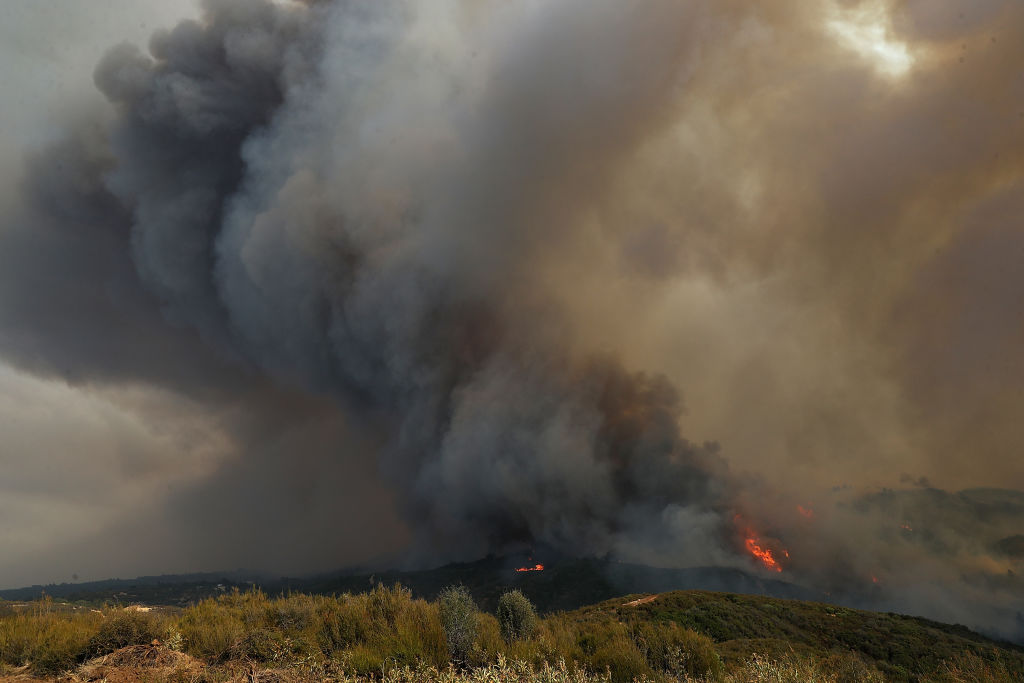
As of Monday morning, Spokane, Washington’s air quality is worse than Beijing and Delhi combined.
Surrounded on three sides by warming-driven wildfires, Seattle is also experiencing its worst air quality on record, according to Cliff Mass, a professor of atmospheric sciences at Washington University. On Sunday, Mass warned that “a smokestorm is imminent for western Washington.”
In Eastern Washington, the air is literally “hazardous.” At 7:15 a.m. local time Monday, Spokane’s Regional Health District tweeted out that “Spokane is waking to ‘hazardous’ or maroon category for air quality.” That means, “At this level, everyone should be staying indoors.”
HAZARDOUS AIR QUALITY: As of 7:15 a.m. today, Aug. 20, Spokane is waking to ‘hazardous’ or maroon category for air quality.
At this level, everyone should be staying indoors.@SpokaneCleanAir has hourly air quality updates: https://t.co/XHrtqpSBws pic.twitter.com/HrRV2hheOr
— SRHD (@spokanehealth) August 20, 2018
The warning is based on PM2.5 levels, which measure the fine particulate matter (PM) smaller than 2.5 micrometers in diameter, much of which is caused by combustion of fossil fuels.
These particles are so tiny — 20 times smaller than the width of human hair — they can bypass the body’s normal defense mechanisms and cause grave harm. Studies have found that PM2.5 concentrations are directly correlated to mortality levels from lung cancer and cardiopulmonary disease.

Equally worrisome, recent studies link particulate matter directly to higher rates of Alzheimer’s and dementia.
In the air quality index (AQI) system used for warning the public (see below), 0 to 50 is considered a “good level,” but anything above 150 is “unhealthy” for all groups, and anything above 300 is “hazardous.”

As of mid-morning Pacific time, the AQI for Beijing is 81. The AQI for Delhi is 173. The AQI for Spokane is 306. The highest recorded level Monday in Washington State is over 400.
While air quality is worst in the states currently battling major wildfires, smoke from the numerous western wildfires has traveled all the way across the country, even to Washington, D.C.
California has been slammed by the worst wildfires on record. But eastern Washington is also ablaze, and British Columbia’s wildfires to the north are so severe that places like Prince George are seeing darkness hours after sunrise.
Downtown Prince George. It is now pitch black. We are in downtown. #BCWildfires pic.twitter.com/nLDm1trQIz
— Richard Zussman (@richardzussman) August 17, 2018
And the reason so many places in North America and around the world are seeing such off the charts wildfires — and that so many places around the world have seen “unprecedented” wildfires in the last few years — is also no mystery.
Climate change is a major cause — despite the fact that President Trump and his Interior Secretary Ryan Zinke have offered all sorts of “comedically ill-informed” alternative explanations, as experts pointed out last week.

In fact, President Trump’s own White House signed off on the actual science behind increasing wildfires. As the November 2017 National Climate Assessment explains, “frequently discussed in the literature is the increase in wildfire risk resulting from the combined effects of high precipitation variability (wet seasons followed by dry), elevated temperature, and low humidity.”
Those wildfires do terrible damage right where they occur, as we’ve seen, but they also harm human health hundreds and even thousands of miles away.
This post has been updated.