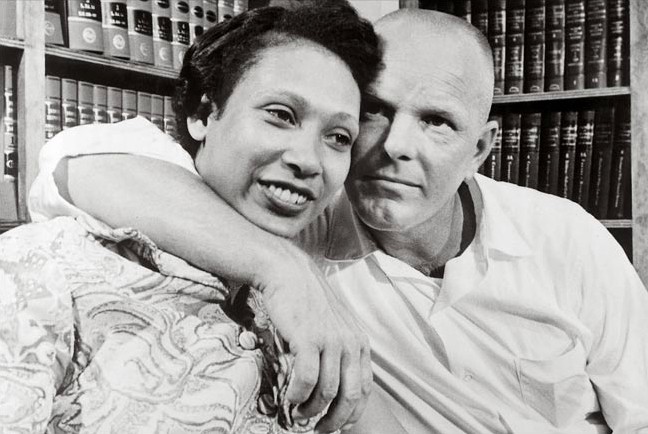
Brad Schimel, the district attorney in Waukesha County, Wisconsin and the Republican nominee to be that state’s next attorney general, said that if he had been the chief legal officer in a Jim Crow state, he would have defended that state’s ban on interracial marriage in court. “It might be distasteful to me,” he claimed when asked specifically how he would have behaved if he were in that position, “but I’ve got to stay consistent with that — as the state’s lawyer, it’s not my job to pick and choose.” Schimel made the statement during a cable access interview last month, though it was reported by the Milwaukee Journal Sentinel on Wednesday.
Schimel and his opponent, Democrat Susan Happ, disagree on whether the state’s attorney general’s office should defend Wisconsin’s ban on marriage equality for same-sex couples, although the issue may soon be moot as a federal appeals court decision requires Wisconsin to grant marriage rights to gay couples. The Supreme Court declined further review of that decision on Monday.
The question of when government lawyers have a legal obligation to defend a law, and when they may refuse to do so, is a difficult and nuanced one — although Schimel’s view is an outlier. One one hand, judges should generally be guided by briefing on both sides of a case before they strike down a state or federal law, and it will be administratively difficult to ensure that both sides of a case are briefed, and also potentially quite expensive, if state and federal attorneys routinely refuse to defend laws in court. On the other hand, as former Solicitor General Wade McCree once explained, “the Solicitor General’s Office is called upon to give full faith and credit to the fundamental law embodied in the Constitution, even at the expense of the federal statute.” This may sometimes require them to refuse to defend a law that is clearly unconstitutional.
In 1990, when Chief Justice John Roberts was acting as the solicitor general, Roberts took an unusually expansive view of the ability of government attorneys to refuse to defend federal laws. He declined to defend an affirmative action program concerning broadcast licensing for minority-owned stations, and even signed a brief arguing that the law was unconstitutional. Despite Roberts’ actions, the law was nonetheless upheld by the Supreme Court.
Two decades later, the Obama administration announced that it would not defend the unconstitutional Defense of Marriage Act, an anti-gay law that was eventually struck down by the Supreme Court.
Although experts disagree around the margins regarding when a government attorney can properly refuse to defend a case, there is widespread consensus that “patently unconstitutional” laws should not be defended. As Rex Lee, who served as solicitor general under President Reagan, once explained, the Justice Department will not defend laws “where the Attorney General believes, not only personally as a matter of conscience, but also in his official capacity as the Chief Legal officer of the United States, that a law is so patently unconstitutional that it cannot be defended.”
So Schimel’s suggestion that he may never refuse to defend a law, even when the law is as clearly unconstitutional as a law requiring racial marriage discrimination, is out of step with the practice of the United States Justice Department, and it is also out of step with the practice in Wisconsin. Current Wisconsin Attorney General J.B. Van Hollen recently refused to defend a Wisconsin campaign finance law which is being challenged in the context of a probe into potential lawbreaking involving Gov. Scott Walker (R-WI). Schimel’s opponent, Democrat Susan Happ, says that she would not defend Wisconsin’s ban on same-sex marriage, its voter ID law or a particular law restricting abortion.