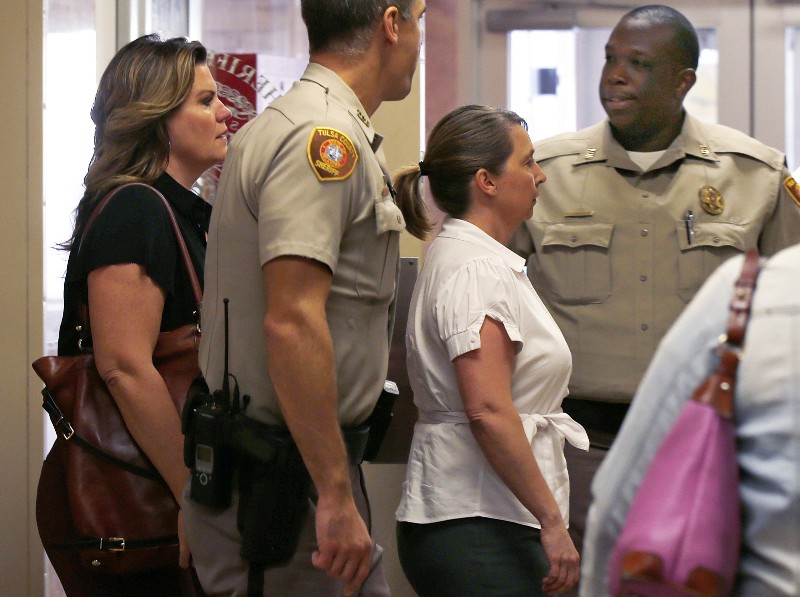
It’s hard not to second-guess what happened next to a broken-down SUV on an empty strip of road in Tulsa in September.
When Tulsa Police officer Betty Shelby shot and killed Terence Crutcher, the 40-year-old black man was unarmed, standing still, and facing her. His hands were empty. Shelby’s backup had just arrived — three officers, including one who was standing immediately to Shelby’s left with his taser leveled at Crutcher. Crutcher turned and moved slowly back to his car, with his hands raised high above his head. Then he turned to face Shelby again. She fired.
Freeze-frames from a helicopter video of the killing indicate Crutcher’s window was rolled all the way up, negating any claim from the cops that he made a move to reach into the cab of his broken-down truck.
All that visual evidence indicated there was no good reason to shoot Crutcher. In response, District Attorney Steve Kunzweiler charged Shelby with first-degree manslaughter, marking just the 77th time a police officer has been charged with murder or manslaughter in the thousands and thousands of police-involved shootings since 2005.

It will probably be a long time before Shelby sees the inside of a courtroom. But her lawyers are already previewing her case in the media — and Shelby’s attorneys have a strange argument they’ll use in her defense.
Shelby had no idea her backup was right behind her, prepared to subdue Crutcher with a less-lethal taser, the lawyers are saying, because she was temporarily deaf due to the stress of the situation. The law enforcement community calls it “auditory exclusion.”
“She didn’t hear the gunshot, didn’t hear the sirens coming up behind her just prior to the shot,” defense lawyer Scott Wood told the Associated Press last week. Auditory exclusion is “the no. 1 perceptual distortion by people I have represented who have been involved in shootings,” he added.
Wood’s scientific-sounding argument will make Betty Shelby’s ears a strange new battlefield in the struggle to reform American law enforcement. If her lawyers manage to present “auditory exclusion” as hard science, her trial will mark a step toward allowing the use of a cloud of medical-sounding jargon to obscure the implicit racial biases that cops carry to explain a killing that has all the hallmarks of the epidemic of biased policing of black people.
Is “Auditory Exclusion” Science or Subjectivity?
Professor Philip Stinson, a former cop and criminal lawyer who now teaches at Bowling Green State University, maintains the most comprehensive database anywhere on police officer prosecutions for killing civilians. Out of 77 officers charged with murder or manslaughter for killing a civilian since the start of 2005, he said, none appears to have argued in court that “auditory exclusion” excused their actions.
“From my standpoint, it’s completely nuts,” Stinson told ThinkProgress. “I don’t see this being admissible at all.”
But researchers diverge on whether people can go temporarily deaf under duress.
Those ThinkProgress reached who study the brain’s physiology said they know of no research supporting it. “Stress does all sorts of things to sensory systems,” wrote Stanford neurologist Dr. Robert Sapolsky, “but the idea of deafening is ludicrous.” Dr. Andrew Steptoe at University College London, who studies “peritraumatic dissociation” during episodes of intense fear or stress, said the idea is plausible “but I know of no solid evidence for this.”
“The idea of deafening is ludicrous.”
But approached from a psychologist’s perspective, the theory is better grounded. Penn State Behrend associate professor Melanie Hetzel-Riggin said it helps to imagine the difference between hardware and software here.
“On the hardware side, they’re right, there’s probably no physiological problem in that your hearing itself is fine. What’s happening is the info isn’t going anywhere,” she said. “It is possible, although I’m unaware of any research supporting this one way or the other, that during that experience of threat your hearing could be focusing on that and not anything else going on around you.”
There isn’t much research out there on perceptual distortion in police officers — roughly a half-dozen survey-based studies going back to the 1980s. The studies found a wide range of hearing distortion rates, from as low as 27 percent in a 1981 paper to as high as 88 percent in findings published in 1997.
“A sizable chunk of police officers that are involved in shootings…experience some sort of auditory occlusion or exclusion,” said Prof. David Klinger, another former cop turned academic at the University of Missouri-St. Louis. “It’s well over half of the officers that I interview.”
“From my standpoint, it’s completely nuts.”
Klinger interviewed 80 officers about 113 shooting incidents, compiling his findings in a 2002 paper funded by the Department of Justice and in a 2009 peer-reviewed study. A full 70 percent reported muffled audio perception that began when shots were fired.
Just 42 percent, however, reported experiencing some “auditory blunting” before firing their weapon — such as would explain the claim in Shelby’s case.
Obscuring Implicit Bias With Hazy Science
Disputes between physiologists, sociologists, and psychologists are one thing. A courtroom is another.
The law treats charges against police officers differently than it does those against civilians, requiring prosecutors to prove a cop failed to meet the “reasonable officer” standard. That allows defense attorneys to re-frame events in the context of officers’ training that any small movement can mean death. But it’s a standard that risks treating a cop’s perception of threat as the basis for deciding guilt or innocence and prohibits juries from second-guessing.
It’s not supposed to work that way, BGSU shootings expert Stinson said.

“It’s an objective reasonable-police-officer standard, not a subjective she-felt-in-danger standard,” said Stinson. And the concept of “auditory exclusion” Shelby’s lawyers raise shouldn’t really have much bearing on whether or not her actions were objectively reasonable.
“We’re chasing the wrong issue. The legal standard is a reasonable apprehension of an imminent threat of serious bodily injury,” he said, and the survey data on auditory exclusion simply doesn’t meet the legal standards for the kind of scientific evidence that juries should be allowed to hear. Courts have established a five-part legal test that essentially boils down to whether or not scientists agree the thing is real, and whether they have figured out how to measure it with confidence.
Still, judges have some leeway in how they interpret those standards. And the filters that are supposed to keep junk science out of the justice system are notoriously porous.
“In criminal trials, it seems that a lot of times things get in as quote-unquote ‘expert testimony’ that should never get in under the legal standard,” Stinson said. “You can get an expert to say whatever the hell you want him to say. It’s just not scientifically reliable.”
Klinger wouldn’t speak to how his research might or might not fit into the case in Tulsa, in which publicly available video shows no apparent fight-or-flight threat.
“I’ve been there and I’ve done that and I’ve pulled the trigger, and it sounded very soft.”
But he noted that while auditory distortions may not have made it into an officer’s criminal trial before, the broader psychological concepts his research deals with have. Klinger himself testified in the trial of a Washington police officer named Troy Meade after prosecutors used Meade’s testimony about visual distortions to undermine the officer’s credibility.
He also acknowledged this is ultimately a matter of what people believe rather than of hard science. “There are always questions about oral histories, the honesty, the integrity, are they misremembering. Is this what they actually experienced, or is it how they’re remembering it?” he said.
“But I’ve been there and I’ve done that and I’ve pulled the trigger, and it sounded very soft. And at that moment I thought, ‘boy, that was odd.’ And then I reached in to continue to grapple with this idiot who was trying to murder my partner.”
The stories in Klinger’s research largely reflect Klinger’s own experience: a weapon, a struggle, a standoff, a clear threat. Almost none of the stories he or other experts point to reflect the circumstances in which Shelby killed Crutcher. Out of 113 shootings from Klinger’s survey data, only four featured unarmed civilians.
This Is What They Train For, Right?
At least once before, auditory distortions have been raised by defense lawyers in civil suits against an officer who killed a civilian in a dubious situation. When officer Stephen Heimsness shot and killed 30-year-old Paul Heenan in Wisconsin in 2012, the dead man’s family sued.
Both the officer and the victim were white, and the fatal encounter happened after Heenan drunkenly stumbled into the neighbor’s house instead of his own. Heenan was unarmed, but Heimsness said he fired because the man moved toward him. A witness said he was shouting, “He’s my neighbor!” at Heimsness when he killed Heenan.
“You can get an expert to say whatever the hell you want him to say. It’s just not scientifically reliable.”
In interrogations immediately after the killing, Heimsness invoked the concepts of visual and audio distortion. Defense lawyers brought in an expert to substantiate the “auditory exclusion” defense, and asked the judge to dismiss the case.
It backfired. The judge rejected the defense’s motion to dismiss in June of 2015, leaving Heimsness and the city of Madison to defend his conduct in front of a jury. They decided not to. Less than six weeks later, the city paid $2.3 million to settle.
Had the case gone to trial, jurors would no doubt have heard experts from both sides argue about the science behind the temporary deafness that Betty Shelby is now invoking in Oklahoma.
But they also would have heard about how the Madison Police Department actively trains officers about the dangers of stress-induced perceptual distortions, flagging tunnel vision and muffled hearing as risks that cops must practice overcoming.

Madison isn’t alone. Police training materials are commonly designed to neutralize the panic psychology that Shelby’s lawyers hope will exonerate her. Simulations like the “force option simulator” at San Diego Regional Law Enforcement Training Center are in widespread use.
With public pressure for reform mounting over the past couple years, police departments have invited reporters to try their hand at the simulators as part of a PR offensive.
The reporter sessions illustrate how your average geek off the street would struggle with the stresses of the job, to be sure. But the point of the training is to ensure cops are better than us at this stuff. The people whom society entrusts with deadly force and unique authority are supposed to know how to avoid such dangerous responses to something that overloads our brain’s fight-flight instincts. Police academies traditionally give 13 times as much attention to training officers to handle violent situations professionally as to deescalation practices.
“The good thing about police officers and other people who are emergency responders is they have all this training to make it muscle memory, to make it automatic,” said Hetzel-Riggin.
“There are many situations that are going to be perceived as less threatening, because police officers have the training, the practice.”
All the training in the world can’t necessarily prevent someone’s perceptive software from going haywire when their system is convinced they’re in immediate danger, however.
“When you’re talking implicit bias, if you look at the research, every single human being even the most liberal person [has it],” said Hetzel-Riggin. “It’s part of the human condition. And there are ways to work on it, but that’s a societal change not an individual one.”