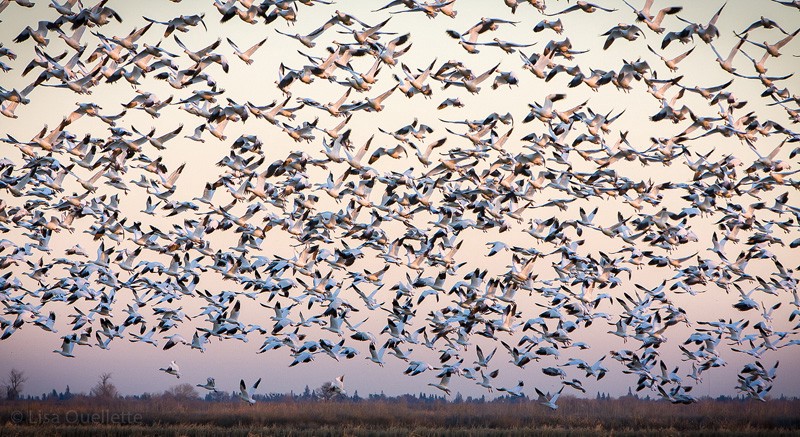
With California’s enduring drought keeping more than four-fifths of the state in severe drought conditions, millions of birds starting their annual migration south will have a much harder than usual time finding rest and feeding stops. However a new, first-of-its-kind program from the Nature Conservancy is alleviating part of this struggle by paying rice farmers to create “pop-up habitats” in their fields for migrating waterfowl. With only around 15 percent of the typically available wetland habitat surviving the drought, this innovative program offers birds traversing the parched Central Valley 14,000 more acres of usable landing strip for the long trip south.
After successfully testing a pilot version this spring, the Nature Conservancy’s new rescue program will help prevent significant die-off of waterfowl and shorebirds by preventing the spread of diseases like avian botulism. Using data to determine where and when migratory birds need habitat, the conservancy is spending “in the six-digit range” to pay farmers who have submitted bids to keep their rice fields flooded during the key migration periods of September and October and early spring 2015. Known as a reverse auction, selected farmers are then paid to keep their land flooded, often using private wells. For the upcoming year the conservancy accepted 80 of 160 bids, securing 14,000 acres of wetland.
Conservancy spokeswoman Lisa Park said the bids were not accepted on price alone, but also based on location and timing to maximize effectiveness.
The Central Valley’s Grassland ecological area has been able to flood just 5,000 of the 30,000 acres normally under water at this time of year, according to manager Ric Ortega. Ortega told the Associated Press that tens of thousands of birds are already crowding into the patch, making disease outbreaks a major concern. Ortega said he is hoping to avoid the kind of botulism outbreak that already killed at least 5,000 ducks at Tule Lake National Wildlife Refuge in northern California.
While California is desperate for water, waterfowl breeding grounds farther north had ideal lush, wet conditions this spring. The U.S. Fish and Wildlife Service estimates that duck numbers are up 43 percent from the long-term average, with 49.2 million breeding ducks across two million square miles surveyed in May and June.
Ducks are just one of the 350 or so species that fly through California’s Sacramento and San Joaquin valleys during their annual migration. Rice farmers provide crucial migratory wetlands for these birds as they flood their fields in the winter to rot away harvested rice stalks. With human development severely limiting California’s wetlands even before the drought, this year these unique outposts are even more critical. Paul Butner of the California Rice Commission told the Associated Press that in a normal years the state’s rice farmers would have 250,000 to 300,000 acres flooded in winter but that this winter that number may drop to as low as 50,000.
When rice grower John Brennan flooded his Sacramento Valley field recently, blue herons arrived immediately and ibis, curlew and other birds followed soon after. Brennan praised the conservancy for the simplicity of the program.
“With the other programs, it could take years to do the same thing,” Brennan said. “This is a simple program. A management team came out from The Nature Conservancy, set up a workshop in Colusa, and three or four weeks later, we’re doing it.”
Economist Eric Hallstein, who designed a reverse auction program, told the San Francisco Chronicle that it’s like how the Oakland A’s operate with “Moneyball.”
“We can make a huge conservation impact with limited dollars,” Hallstein said. “With the drought and so little habitat, the numbers of birds that will benefit could be mind-blowing this year.”