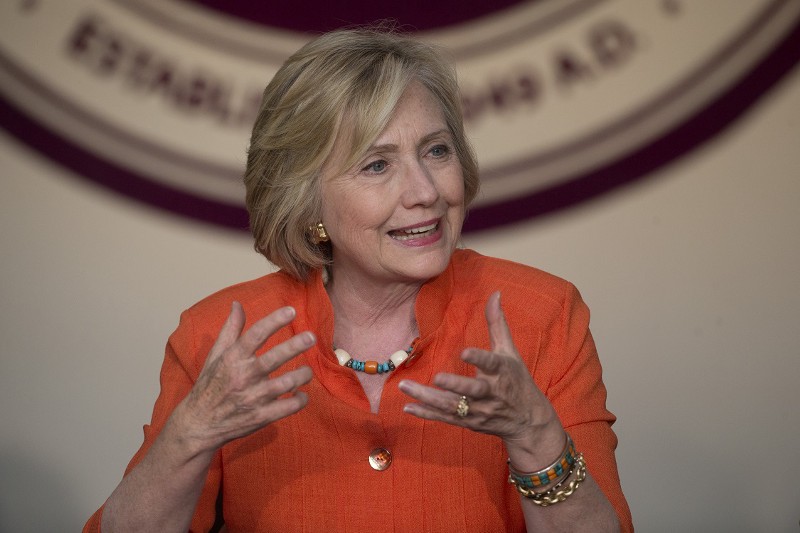
Democratic presidential hopeful Hillary Clinton will announce her college affordability plan on Monday at a high school in New Hampshire.
Under her plan, which would cost $350 billion over 10 years, students could attend a public university and not have to take out loans for tuition. States would be encouraged to gradually increase spending on public colleges and curb a fast rise in tuition through $175 billion in grants to assure students they would not have to take out loans to afford tuition at those schools. Those states would be encouraged to enroll more middle class and low-income students and lower living expenses. The plan would be paid for by placing a cap on the itemized deductions higher income households are able to take through tax returns.
College affordability has been a hot topic recently after Corinthian College students’ debt strike and the movement’s subsequent talks with the U.S. Department of Education, along with reports of misrepresentation of job placements for for-profit colleges, which can have higher tuition than comparable colleges. Total student debt in the U.S. is currently over $1 trillion.
Although many of Clinton’s supporters were hoping for a debt-free college plan, Tamara Draut, vice president of policy and research at Demos, called it “the most substantial and progressive plan any policymaker has ever put forth to combat our student debt crisis.” Unlike the plans proposed by her opponents on the left, former Maryland Gov. Martin O’Malley and Sen. Bernie Sanders (I-VT), Clinton’s plan would require working more with states to institute change.
O’Malley’s debt-free college plan, which was unveiled last month in New Hampshire, aims to lower tuition at public universities by freezing tuition rates and make loan repayments automatically correspond with income. O’Malley’s plan freezes tuition rates while Clinton’s does not offer any set tuition cap for public colleges.
O’Malley’s plan would also tie tuition rates to median income by lowering the cost of tuition to, at maximum, 10 percent of the state median income at public four-year institutions, and a maximum of 5 percent of median income at two-year public colleges. The plan would focus on more than tuition by increasing Pell Grants and state grants so they can cover non-tuition costs. O’Malley also offered support for older students, first-generation college students, and parents in the form of childcare at colleges and expanding counseling programs.
In May, Sanders introduced the College For All Act into Congress, which would eliminate undergraduate tuition at four-year public colleges, let students refinance student debt at a lower interest rate and expand work-study programs. States would pay for a third of the cost of tuition and the federal government would pay for other two-thirds. Student loan rates would be lowered to 2 percent for undergraduate students, would be tied to inflation and have a cap of 8.25 percent. The plan would also cost a lot more than Clinton’s at $750 billion over 10 years. It would be paid for through a financial transactions tax on certain stock trades.
Sen. Marco Rubio (R-FL), who is also running for president, already spoke out against Clinton’s plan on Fox & Friends Monday morning, calling it “outdated” and suggesting that instead of focusing on how to make the current model affordable, there should be a renewed focus on “competition” and online coursework. Rubio has defended for-profit colleges and touted massive online open courses, or MOOCs, in the past and suggested that they were a better fit for busy Americans. Rubio also wants to loosen rules on accreditation, which some critics say are already loose, and suggested income share agreements to make college more affordable. Those agreements allow investors to invest in students by paying some of their tuition in exchange for students providing a certain amount of their income for so many years.
New Jersey Gov. Chris Christie (R), another presidential contender, has suggested students use income share agreements as well.