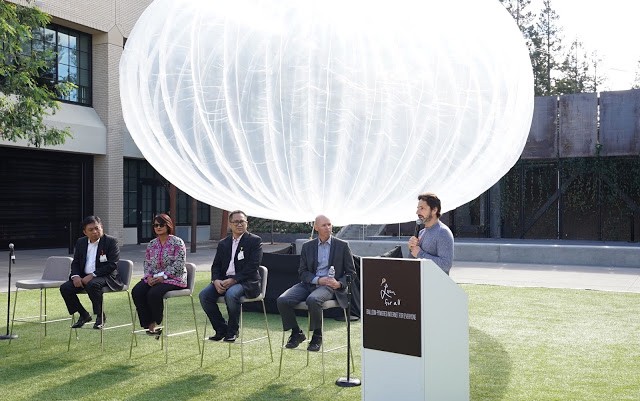
Google and Facebook are in a race to connect the world, but where the social network has been criticized for its efforts, Google is looking to excel in style by delivering fast internet access to Indonesia with a series of wind-cruising balloons.
The company plans to set free hundreds of balloons equipped with high-speed LTE mobile internet connections that will serve over 100 million people. About one-third of Indonesians have internet access — with rates hovering around 16 percent have been reported — compared to 43 percent of people in East Asia and Pacific region have internet access. Those numbers may begin to shrink if Google’s mobile balloon network through Project Loon takes off.
Project Loon got its start in New Zealand in 2013, where researchers launched 30 solar-powered balloons to test whether a continuous internet connection could be established. To do this, the balloons mimic cell towers but float in the stratosphere at altitudes double that of commercial airplane flights. Google partnered with local telecom providers Indosat, Telkomsel, and XL Axiata, to test internet connectivity in 2016.
The project has large implications for internet access for developing countries. Facebook has been working on a similar goal through its Internet.org program via satellite and traditional mobile networks to delivers users mobile internet access to select media organizations and Facebook’s mobile apps. But the company’s apparent altruistic initiatives have been criticized as half-steps that cheat an already disadvantaged communities, violating the tenets of net neutrality — the principle that all internet traffic should be treated equally.
Months after the Federal Communications Commission made net neutrality the law of the land, Indian open internet advocates in India launched a campaign criticizing Facebook and CEO Mark Zuckerberg for partnering with local telecom companies that planned to charge app makers for customers’ data usage. That practice, known as zero rating, limits which apps users could access through Internet.org to more established and wealthier companies, an effect that could trickle down to what content users can access and absorb.
Zuckerberg fired back at protesters Tuesday at a town hall meeting at the Indian Institute of Technology in Dehli, saying that free internet access in any capacity is a win.
“When you have a student who is getting free access to the internet to help do her homework, and she wouldn’t have had access otherwise, who’s getting hurt there? We want that. There should be more of that,” he said.
What does hurt people, Zuckerberg said, was when telecom providers charge customers for access to certain content: “That’s the kind of thing you can see hurts people, and you want net neutrality regulations in place that are going to prevent that.”
Activists retorted the Facebook CEO’s stance in an open letter for SavetheInternet.in:
Even today, Internet.org has restrictions that those services which compete with telecom operator services will not be allowed on it. WhatsApp would have never emerged on this platform. We fail to understand why, if it is an open platform, someone even needs to apply, and conform to your pre-defined technical limitations, and has to go through unspecified checks determined by your organization.
Google could face similar opposition as its balloon-powered internet takes off. Facebook and Google supported net neutrality in the U.S., but a recent news report from MediaNama claims the search engine company lobbied against net neutrality regulation and supported zero rating in India alongside Facebook.
Update:
This post originally said Google’s internet access was free. It is not.