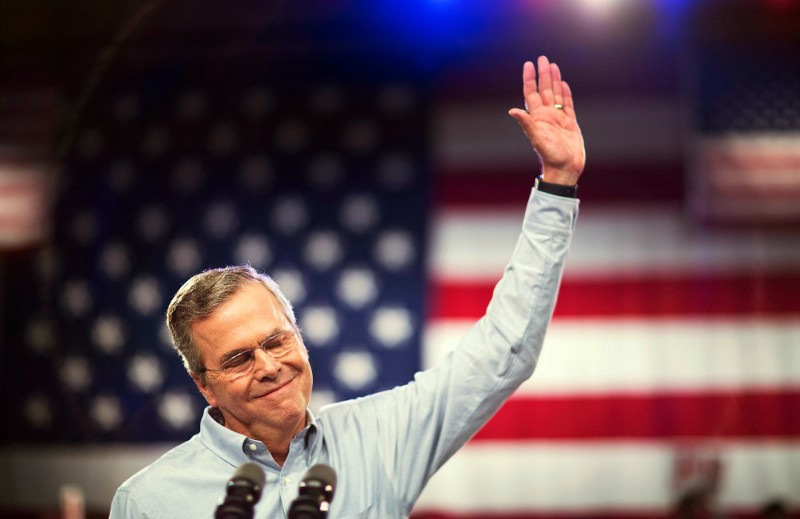
FORT LAUDERDALE, FLORIDA — When former Florida Governor Jeb Bush looked out over the sea of faces at the Urban League’s annual conference Friday morning, he found a cautious and skeptical reception, with little applause. In his speech, he touted his record as governor — including appointing judges of color, taking down the Confederate Flag, and massively expanding charter schools and vouchers — as one dedicated to civil rights.
“I believe in the right to rise, and a child is not rising if he’s not reading,” the Republican candidate for president said, before criticizing teachers’ unions for opposing charter and voucher school programs that draw funding away from public schools. “So we said, let’s change the law, let’s go build a charter school, let’s start something new and hopeful for people who shouldn’t have to wait for a real opportunity.”
His achievements as governor, he said, are “a record I’ll gladly compare with anyone else in the field.”
But a group of local teachers who gathered outside the convention center challenged Bush’s characterization of his tenure as governor.
“He completely dismantled and dismembered public schools in Florida, which hurt hundreds of thousands of students of color,” said Thomas James, a high school social studies teacher in Miami-Dade County, who woke up before dawn to protest at Bush’s address. “He’s down here now to suck up for a few votes, but we know the worst thing for this country would be to have this jerk in the White House.”
In the Friday address, Bush either did not mention or glossed over some of his actions as governor that had an arguably negative impact on Floridians of color. In 1999, he ended affirmative action in state universities by executive order, becoming the first governor ever to do so. Since then, incoming classes at Florida’s colleges have become less diverse. Black high school graduates were the most impacted, with African American enrollment falling nearly 11 percent between 2000 and 2013.
Soon after, Bush carried out a controversial voter purge that disproportionately removed black voters from the rolls, just before the contentious 2000 election and Supreme Court battle that put his brother George W. Bush in the White House.
His speech did touch on his record on prisons, saying: “In Florida, we didn’t want to fill prisons with non-violent offenders. So we expanded drug courts and prevention programs. I took the view — as I would as president — that real justice in America has got to include restorative justice.”
Yet Bush also signed a bill during his first year as governor that increased some mandatory minimum sentences for juvenile offenders. He also worked to block efforts to decriminalize or legalize marijuana, and fought to keep harsh sentences for non-violent drug offenders, even though he was a regular smoker in his youth. In 2002, he opposed a ballot measure that would have allowed drug offenders to enter treatment programs instead of prison.

In 2005, Bush signed a Stand Your Ground gun law that inspired similar laws in nearly half of U.S. states. In the two years that followed, the number of gun-related homicides in Florida jumped by more than 200 cases. According to data from the Florida Department of Law Enforcement, so-called “justifiable homicides” in the state tripled in the five years after the law’s enactment, compared with the five years before — from an average of 12 killings to 36 killings per year. The gun homicide rate in the state has remained higher than the national average ever since.
Though Bush has touted his current campaign as an inclusive one, he has made recent remarks that have angered communities of color.
Just a few weeks ago, Bush remarked that the mass protests that rocked Baltimore and Ferguson were caused by a lack of mentoring for young people of color — making no mention of the police killings that sparked the unrest.
Police violence “ignited the spark,” emphasized Urban League President Marc Morial at Friday’s conference. “But hopelessness and joblessness are the tinder and the kerosene.”
Other civil rights leaders at the Urban League conference voiced disappointment that Bush failed to answer for the thornier parts of his record.
“We demand more than a smile and a wave from the candidates. It’s not enough for them to give us their best lines. We need firm commitments and firm plans,” said Reverend Al Sharpton. “We don’t need to be entertained. We need to be engaged with real policies.”
Sharpton says Jeb Bush and other candidates have not yet offered convincing plans to tackle unemployment, income inequality, criminal justice, and education, and for him, he wants a promise to at least not “turn around what [Obama] began.” Yet Bush and his fellow Republican candidates have vowed to do just that. Whether it’s the Iran nuclear agreement, the diplomatic opening with Cuba, the Affordable Care Act, or the DACA program that shields young immigrants from deportation, Bush has promised to roll back the majority of President Obama’s signature policies.
The only way to make sure that doesn’t happen, Sharpton said, is continued agitation. “We need to make sure that when the first black family leaves the White House, black concerns don’t leave the White House with them.”