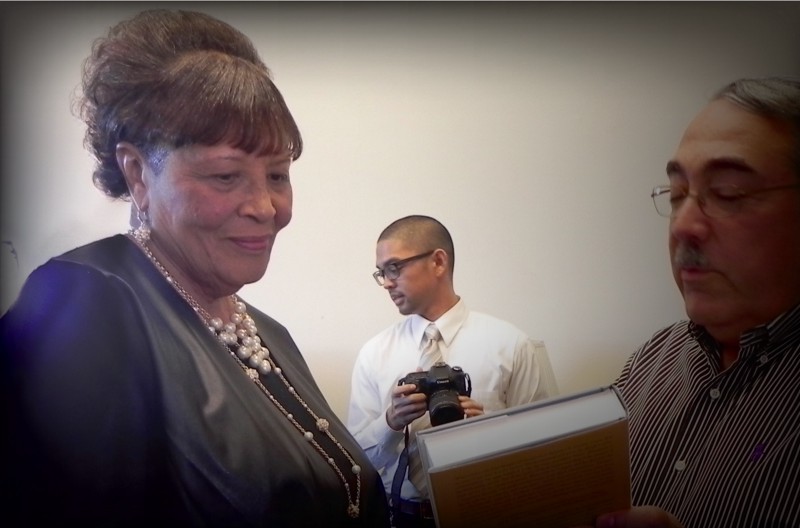
WASHINGTON, DC — -On Wednesday night, Rep. Elect Alma Adams (D-NC) will place her hand on a Bible and be sworn into office by House Speaker John Boehner, becoming the record 100th woman to serve in the 113th Congress.
Unlike most of the men and women who won their races last week, Adams will begin work immediately, because she is filling a seat in North Carolina’s 12th district that has sat empty for the past 10 months. Sitting in her still-empty office across from the US Capitol, she told ThinkProgress her first priority will be setting up offices in DC and North Carolina and reaching out to her hundreds of thousands of constituents to “determine what the needs of people are.”
“We want people to understand that they do have representation now and we’re going to address their concerns and work for them,” she said.
And the calls are already pouring in. Adams’ constituent services staffers told ThinkProgress that the office has already been contacted by students from the district’s several historically black colleges and universities concerned about federal funding, senior citizens from the Charlotte suburbs dealing with the Medicare and Social Security bureaucracies, and wounded veterans trying to get treatment at the VA in Salisbury.
Thanks to some spectacular gerrymandering (see below) just two of North Carolina’s 13 U.S. House districts have a majority of voters that are not white, including the one represented now by Rep. Adams. The district, which snakes across six different counties to include the urban centers of Charlotte and Greensboro is an example of what she has called the “stacking and packing African Americans,” a practice that has made all the surrounding districts safer for Republicans.

When the district’s former representative Mel Watt (D-NC) stepped down in January to become the President’s new Federal Housing Finance Agency director, North Carolina Gov. Pat McCrory (R) announced that he would not hold a special election to replace him until November. The governor justified leaving the district’s hundreds of thousands of residents with no congressional representation for nearly a year by arguing it would “avoid voter confusion” and save taxpayers a sum “in excess of $1 million.” He defended the decision in an interview on MSNBC, saying, “Not much goes on in Washington between July and the election anyway.”
But by delaying the special election, North Carolina’s majority-minority 12th District did not have a vote on major domestic and international issues covered in bills passed this year. As the North Carolina NAACP noted, “While the Congress debates the Farm Bill, budget issues, immigration reform, historic national security issues, and the future of Section 4 and 5 of the Voting Rights Act itself, the 12th District — -comprised of citizens of North Carolina from all walks of life: Black, Latino, White, poor and rich, hard-working democrats, republicans, and independents — -will be without a voice.”
Adams told ThinkProgress Wednesday that the experience has made her even more sympathetic to the residents of DC, who are permanently without a vote in Congress. “I believe in a democracy, and in a democracy everyone is represented,” she said. “By not having a vote, you really don’t have a seat at the table. Full representation requires a vote.”
Rep. Adams emerged victorious from a seven-way primary this spring in which she was the only woman candidate. She then handily won in November against her Republican adversary. As soon as she’s a full member of the House, Adams says she will prioritize legislation to raise the minimum wage to a living wage, assist the unemployed, and reauthorize the Voting Rights Act. Soon after the Supreme Court struck down a key provision protecting voters in areas with historic racial discrimination, North Carolina’s Republican-controlled legislature quickly passed the VIVA bill, which stands for Voter Information Verification Act and is considered one of the worst voter suppression laws in the country. Adams calls it the Voter Intimidation and Vilification Act, and says it’s a perfect example of why Congress needs to step in and fix the situation.
“If we look at all of the regressive, punitive actions that our legislature took, we need that oversight from Congress,” Adams said. “I don’t think we can trust or should trust the vote of the people — which is so special — to politicians in that way. We’ve already seen what can happen when legislatures take advantage of that.”
Adams also hopes to tackle the persistent gender wage gap. “If this were in the reverse, and men made less than women, we wouldn’t even be talking about it because we would have resolved it by now! I really believe that,” she told ThinkProgress.
Adams comes to DC with an extensive resume: 20 years in North Carolina’s General Assembly, many of them overlapping with her nearly 40 years teaching art history at Bennett College in Greensboro. As a mother and grandmother of both public school students and teachers, she began her public service career on the local school board. “I was very concerned about some of the inequities there, some of the school closings. I started as an angry parent, and now I’m an angry grandparent!”
With Adams in the Capitol, women will comprise 100 of the Congress’ 535 members. They stand to gain a few more members this January, but the numbers will remain far from equal to their share of the population. Adams said she feels both “great honor” and “a lot of responsibility,” not only to be an advocate for women while serving in Congress, but to encourage and support more women running for office. “Being the 100th woman helps me add a little more fuel to the fire,” she said.