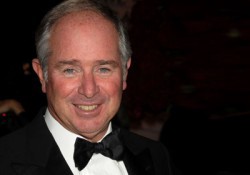
If Mitt Romney is trying to shed his image as an out-of-touch banker, yesterday did not help. On the same day the GOP frontrunner revealed that he pays a much lower tax rate than many middle-class Americans, the founder and CEO of the world’s largest private equity fund hosted Romney and a select group of other financial elites for a top-dollar fundraiser and strategy session at his ultra-posh Manhattan home.
The venue was the Park Avenue apartment of Stephen Schwarzman, the 66th richest person in the world, a 24-room duplex once owned by John D. Rockefeller Jr. that Schwarzman purchased for “$30-something-million” — the highest price ever paid for a New York apartment at the time. There’s even a book about Schwarzman’s building: 740 Park: The Story of the World’s Richest Apartment Building. (Mega-conservative donor David Koch and former Merrill Lynch CEO John Thain also live in the building, though no word if they attended the fundraiser.)
But more noteworthy than Schwarzman’s apartment is the conversation that was likely going on inside. CNBC reports the discussion was sure to be how to “counter attacks from President Obama about Romney’s record at the helm of private equity-firm Bain Capital.” Here’s one approach of Schwarzman’s from 2010 that Romney probably shouldn’t follow:
“It’s a war,” Schwarzman said of the struggle with the [Obama] administration over increasing taxes on private-equity firms. “It’s like when Hitler invaded Poland in 1939.”
Attendees at the board meeting (who provided details on condition that they and the organization not be identified) were shocked. “War? Hitler? Poland? A little over the top for a proposal to make hedge-fund managers pay their fair share in taxes,” one attendee says about the comments.
The tax in question is a particularly pernicious loophole (called “carried interest”) that lets private equity executives and hedge fund managers pay a lower tax rate on their income than other working Americans. As ThinkProgress economics editor Pat Garofalo notes in the Atlantic, “private equity managers are allowed to pay the [lower] capital gains rate on the profits they make managing someone else’s money, not for any risk that they take themselves.” It’s a loophole that benefits only people like Schwarzman, who are already extremely wealthy, and does nothing to encourage investment. Congress has tried to eliminate it several times, but has been always been thwarted by concerted lobbying and Republican intransigence.