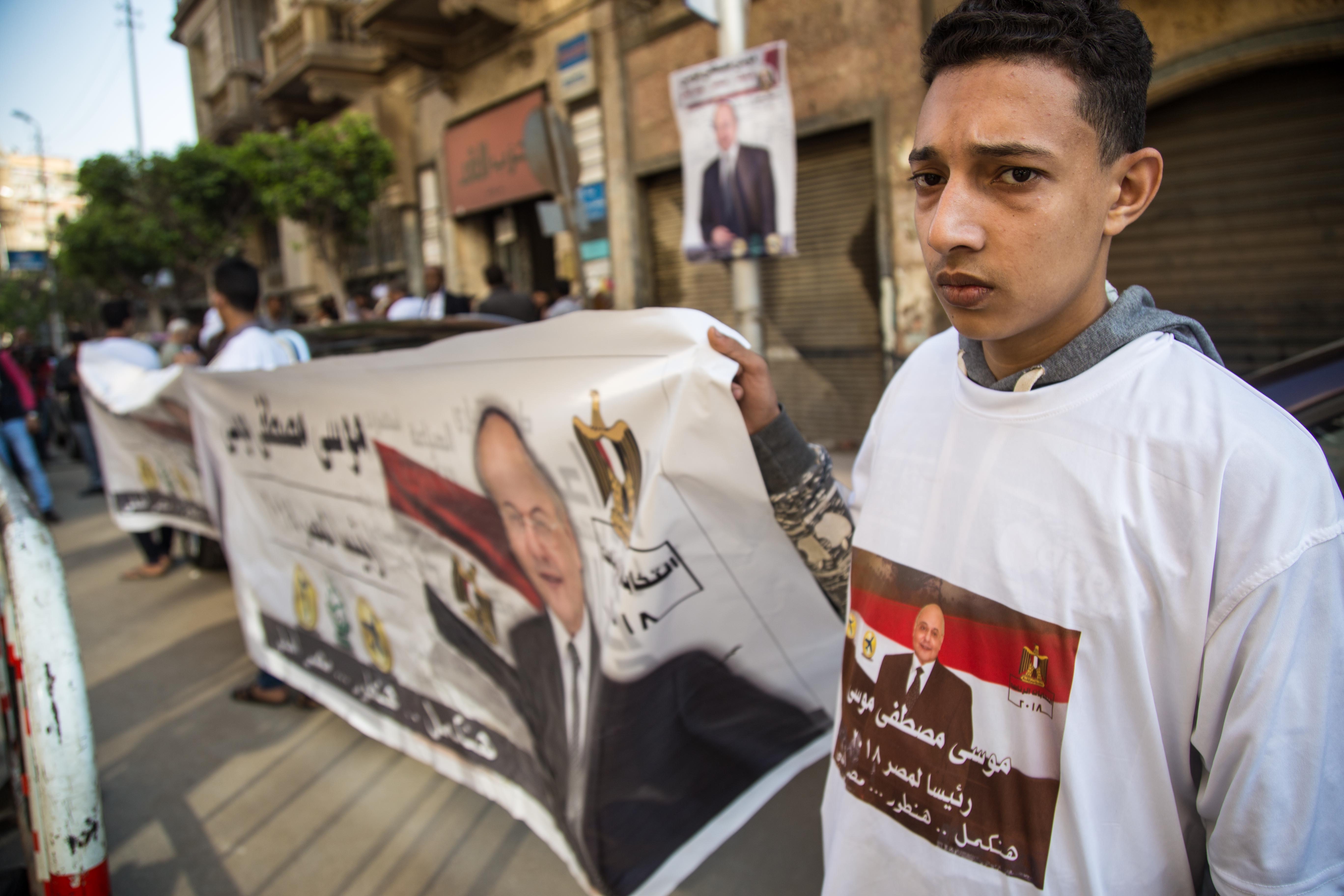
Egyptian expats will be able to vote this weekend, but the choices on the ballots are essentially between current president, General Abdel Fattah al-Sisi, or his supporter, Mousa Mostafa Mousa, who submitted his candidacy papers 15 minutes prior to the deadline and hasn’t bothered to campaign in a major poll in the region’s most populous country.
In fact, Mousa’s El Ghad party had supported Sisi’s nomination for a second term up until the moment that Mousa announced his candidacy, saying he had done so only because all the other candidates had withdrawn from the contest. The race will take place in Egypt from March 26 to 28 and will, by most accounts, be a total disaster.
Indeed, none of Sisi’s original challengers remain standing, but what Mousa does not mention is why those candidates dropped out:
- Sami Anan, a retired general, was arrested in January shortly after announcing his candidacy. He was accused of forging documents and withdrew his candidacy. His top campaign aid was also attacked and detained.
- Mohamed Anwar Sadat, the nephew of assassinated Egyptian president Anwar Sadat, chose not to run after he said he was threatened.
- Ahmed Shafiq dropped out after being arrested by police in the United Arab Emirates, deported, and detained in Egypt.
- Khalid Ali withdrew his candidacy after several members of his campaign staff were arrested.
- Ahmed Khonsawa was jailed right after announcing his intentions to run in December.

Even Abdel Moneim Aboul Fotouh, who was a 2012 presidential candidate running against Mohamed Morsi — the Muslim Brotherhood candidate who won, only to be deposed by Sisi in a bloody coup by the summer of 2013 — has been repeatedly detained in recent months for criticizing the upcoming elections.
“This guy hasn’t been arrested, I don’t think, for like the last 25 years, even under [former President Hosni] Mubarak,” said Amr Magdi, the Human Rights Watch researcher focusing on Middle East and North Africa. “So the climate is very tense, very tight.”
Even for people who are neither into politics nor activism, Magdi said the upcoming elections “look like a farce.”

Michele Dunne, director and senior fellow at the Carnegie Endowment for International Peace’s Middle East Program said that even within the context of Egyptian politics, which have always been somewhat messy, these current elections are “a hot mess.”
The country came out of decades of authoritarian rule with the 2011 uprising, leading to the 2012 election, the 2013 coup and 2014 elections that resulted in Sisi, then the defense minister, becoming president. He promised a lot: That he would stick to the two-term limit in the constitution, that the country would hold free and fair elections every year, and that the lives of Egyptians would improve.
“What’s clear in this election is that he’s violating one promise after another,” said Dunne. What she sees happening in Egypt is a kind of incremental authoritarianism. The 2014 elections were not entirely free and fair, but there was credible opposition. This time, there’s really no opposition at all (Mousa has no hope of winning, even if he really wanted to). And Dunne thinks it’s a matter of time before Sisi amends the constitution to eliminate term limits or extend the limits to give himself Mubarak-like powers.
Yet another sign of trouble is the fact that independent civil society groups aren’t turning up to monitor the poll; official numbers indicate there’s a 44 percent drop in the NGOs registering to monitor the vote from 2014 election. And the government has extended the vote for both expats and domestic voters to three days each. This doesn’t look good to anyone.
“Even those who are pro-Sisi say that the government didn’t do a good job in at least making the elections look real,” said Magdi, saying that the elections are essentially a one-man referendum, which is actually allowed under the Egyptian constitution.
“[W]e are strengthening an arm of the government, the military, that has become way too dominant, and is carrying out massive human rights abuses.”
But doing so may have angered Egyptian youth who already feel betrayed, with the promises of the 2011 uprising that saw the ouster of strongman Mubarak fading into a distant memory. Already, Magdi said that many of the activists who haven’t been arrested have fled the country.
Sisi could actually win a fair election — he has significant support, said Magdi. Still, as Dunne, who had a long career as a Middle East expert in the State Department recently wrote, Sisi has reasons to be nervous, and so must give the appearance of being democratically elected, both to Egyptians and to the international community. But she also wrote that there’s a chance that the turnout will be falsified.
![An Egyptian TV host Ahmed Moussa calls for homosexuality to be punishable by execution. [Screengrab/YouTube]](https://i1.wp.com/thinkprogress.org/wp-content/uploads/2017/11/egypt.jpg?w=853&crop=0%2C0px%2C100%2C534px&ssl=1)
Unlike its recent criticism aimed at Venezuela — in which the administration of Donald Trump charged that President Nicolas Maduro has subverted the course of democracy with sham elections — the United States seems to be playing along with Sisi, cutting only 15 percent of its military aid as a means of showing dissatisfaction with human rights violations there.
But Egypt — which is battling internal insurgent attacks, as well threats from unstable, neighboring Libya — still receives massive aid and support from the United States.
“Egypt is a long-time ally. We have invested deeply in this relationship since the 1970s — we are tens of billions of dollars into this relationship, in both military and economic aid,” said Dunne, pointing out that Egypt is second only to Israel (granted, “by a mile”) in the economic aid it receives.
“We want Egypt to be stable, and in order for it to be stable, we realize that the citizens of the country have to be reasonably content with their lot — politically, economically, and so forth — and we can see that they’re not,” she said. There are concerns that Sisi’s extreme oppression and human rights abuses are feeding radicalism and might give rise to a major insurgency there.
“The question is what do to about it,” she said, adding that “pulling the rug out” entirely from under Egypt might trigger a major collapse in a country of nearly 100 million people in a geo-strategically crucial area — close to Israel, Libya, and a short distance from U.S. allies in Europe.

“I don’t think that the United States does enough — to look itself in the mirror and say, ‘What kind of a role are we playing here? What kind of a role are we playing in our engagement in this country?’…[W]e are strengthening an arm of the government, the military, that has become way too dominant, and is carrying out massive human rights abuses,” said Dunne. Other Western partners, such as France and Germany, also have significant concerns with Egypt, while Russia and China, she said, are happy to have a military government there.
So, the fix is in: Sisi will win. That’ll be a familiar feeling for the retired general, who won by a landslide — almost 97 percent — in 2014, ushering in a new era of Egyptian nationalism that has seen any opposition brutally squashed, locked up and arrested, along with countless journalists, human rights lawyers and activists. Non-state media has been shuttered, LGBTQ activists have been rounded up and sentenced to lengthy prison terms.
And even after this election, Magdi said the odds of the LGBTQ activists being released are slim — only those who were arrested owing to their direct support of struck-down opposition candidates might be released, said Magdi.
“We’d hoped that the elections would bring some political opening, some easing of the situation, but on the contrary, it brought more oppression and an escalation of the government crackdowns,” said Magdi.
And a Sisi win will only make things worse, unless Egypt’s Western partners leverage their support — money, weapons, and intelligence — to force Sisi to improve human rights in the country.
Not doing so, he said, is a short-sighted strategy, allowing for short-term stability without addressing the root causes that lead to the January 2011 uprising to start with. And Sisi, said Magdi, has been banking on this lack of political will to pressure him.
“We’d hoped that the elections would bring some political opening … but on the contrary, it brought more oppression.”
“This was part of their calculation … the [Egyptian] government knows that their allies in Washington or London will not speak up about the violations that are happening … they are just dealing with him as a matter of fact, and that’s a problem,” said Magdi.
Dunne offers a stark warning for why Americans should care about what’s happening in Egypt — aside from the fact that it’s U.S. tax dollars at work, supporting a military government that’s trampling human rights.
“People who thought, ‘Why do we need to care about Syria?’ should look at what happened in Europe and how that affected European politics; this massive flow of refugees from Syria into Europe and how that [impact on our allies] affects us here,” said Dunne.
“If things really go south there, in terms of the terrorist insurgency really taking off, a disastrous economic situation, akin to what we see in Venezuela — both of those are real possibilities … this will have a great effect on our allies, whether we’re talking about Israel, or whether we’re talking about Europe, and that in turn affects us,” she added.