Wedgewood Church in Charlotte, North Carolina isn’t shy about its progressive beliefs. Its website includes a banner that reads “Wedgewood — A Liberal Church,” the congregation actively opposed North Carolina’s ban on same-sex marriage, and the community lists respecting LGBT people, members of other religions, and atheists as a “core beliefs.” So it wasn’t all that surprising when leaders added the phrase “LGBT Equality” to the church sign earlier this month.
But on August 20, parishioners woke to find their church emblazoned with a very different message: Hastily-applied spray paint obscured the sign’s call for inclusivity, and the sanctuary door was marred with large, black letters that read, “Fags are Pedos.”

Chris Ayers, the church’s pastor, said his heart dropped when he saw the damage.
“As a pastor I thought about all of the stories of rejection I’ve heard [from LGBT people] over the years,” Ayers, who blogs under the name “Liberal Rev,” told ThinkProgress. “That vandalism was a symbol of all of that negative stuff.”
Ayers called the incident “heart-piercing,” but noted that the church was also vandalized seven years ago, when someone broke into the church sign and rearranged the letters to read “A Lesbo Church.”
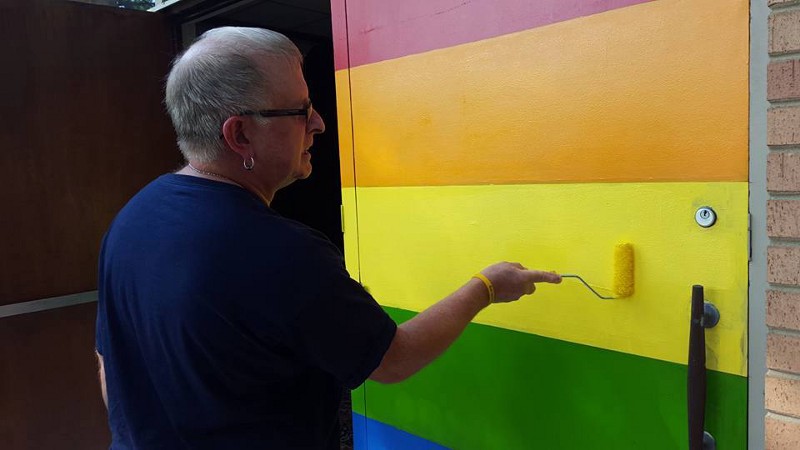
Instead of wallowing in frustration, however, Ayers and Wedgewood — which is affiliated with the left-leaning United Church of Christ and the American Baptist Churches USA — turned the incident into a chance to make their church an even brighter beacon for LGBT equality. Just two days after the incident, the congregation gathered to worship, remove the messages, and repaint the door — as a giant rainbow flag.
“We didn’t want the focus to be on the damage to our church property, but on the damage that has been done to LGBT Christians through systematic abuse from so many — and, sadly, from so many denominations and Christians,” he said.

A worship service was designed to commemorate the painting project, including hymns such as “We Will Not Be Moved” and recitations of quotes such as “May the swords of vandalism be turned into plowshares of dialogue, understanding, and reconciling love.” Jim DeMaine, a gay member of the church who Ayers said was both “an art major and offensive lineman for Elon University,” volunteered to help direct the art project.
Several media outlets quickly covered the church’s story, and messages of support began to pour in. Ayers said most of the emails he received were celebratory, but many included stories of LGBT people who had complicated — or often, fraught — encounters to Christianity.
“The hard part has been the emails from LGBT people who have described their conflicted relationship with the church and with God,” he said.
Asked to explain the intent of the door-painting, Ayers said the congregation was hoping to send several inclusive messages at once.
“[The door] says that one’s sexual orientation and gender identity are not sins, but blessings from God,” he said. “It’s a celebration of the courage of LGBT people over the years to enable the progress that has been made recently. It’s about full equality of all. It’s a prayer for healing for people who have been discriminated against and abused by the church. And, finally, it’s an example of positive, non-hateful response to homophobic people.”
The experience at Wedgewood is inspiring, but attacks on LGBT-affirming churches are increasingly common. In 2008, a gunman stormed a Unitarian Universalist church in Tennessee, murdering two because he “hated the liberal movement” and disagreed with the congregation’s acceptance of LGBT people. And shortly after the Presbyterian Church (USA) voted to support same-sex marriages in March of this year, several of its member churches in Missouri received cryptic messages threatening to burn their buildings “to the ground.” Two months later, a pastor in Hartford, Connecticut was shot outside his church in what authorities suspect was a reaction to his conciliatory stance towards LGBT people.